
This is the future site of the World Federation. A work in progress.
Visit Occupy Earth to join the nonviolent civil-resistance movement to establish a democratic World Federation. If you believe that you have skills to help, please volunteer at Occupy Earth, or write to [email protected]
This is a holding page for the World Federation (worldfederation.net). The site is scheduled to launch in the 3rd quarter of 2026.
Here are answers to some common questions about World Federation:
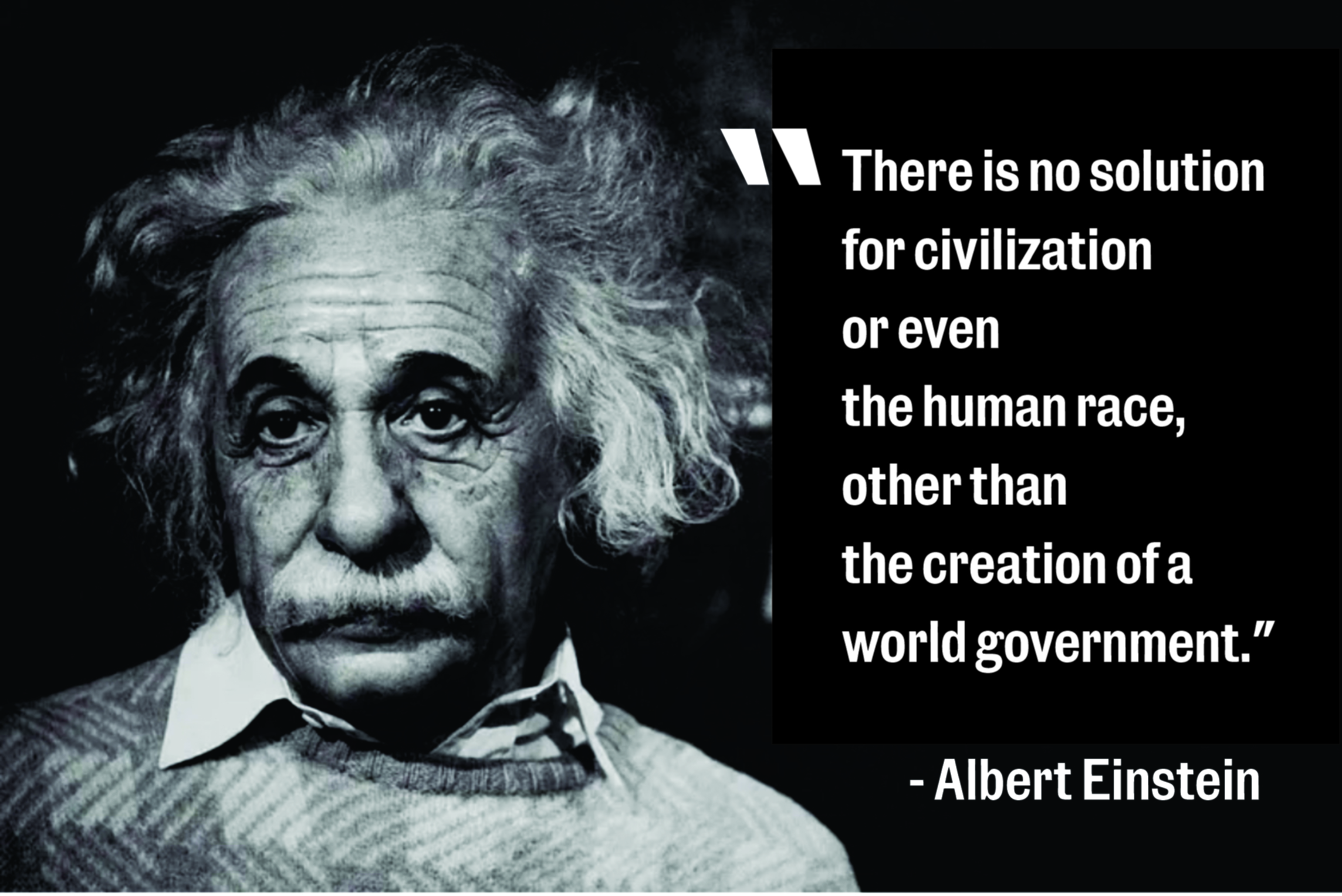
Q. What did Einstein mean by the quote above?
A. He understood that rivalrous nation-states can only be kept in check through enforceable international law. His reference was, of course, to the nuclear arms threat, but his insight now applies equally to other existential threats such as the climate crisis and unchecked AI development. No single country will give up its weapons, implement real climate solutions, or take its foot off the accelerator of AI development, as doing so would put it at a competitive disadvantage relative to others. Without a World Federation, nations (and corporations) are in a perpetual race to beat each other, and that ends in catastrophe.
Q. Doesn't the UN already fulfill this role?
A. No, the United Nations, while well-meaning and quite effective in some areas, is severely hampered in its primary mission - "to maintain peace and security among nations." Conventional wars continuously break out, with the threat of nuclear escalation ever-present. And new, existential threats - like the climate crisis - have emerged since then that the UN has no power to regulate. It is time to establish a democratic World Federation.
Q. Is this a George Soros conspiracy to rule the world?
A. No. Quite the opposite. No single person or group of elites will have any control over a properly constructed democratic World Federation.
Q. How will the World Federation function?
A. The World Federation will function as a democracy, much like democratic governments in other parts of the world. There will be a parliament representing the world's citizens, and another body representing nation-states. There will be an executive branch and a judicial branch. And there will be a law enforcement agency.
Q. What powers will the world government have?
A. The World Federation will have powers limited to global issues - issues that affect all of us. So, for example, war (and nuclear war) will be declared illegal. The climate crisis will be addressed through legislation requiring all countries to reduce their emissions in a fair manner. The development of AI, for example, will impact everyone on the planet, so it would also need to be regulated. These laws and regulations will be enforceable under the World Federation.
Q. This seems impossible. How is this going to happen? There’s no way that China, Russia, or the US, for that matter, will go for it.
A. That may be a correct assessment under current conditions. However, history suggests that whenever a nonviolent movement attracts at least 3.5% of the population, it has almost always been successful. International polls show that 50%-89% of the world's population agrees with our mission to end war, halt climate change, and reduce the threat of AI.
Yes, there will be significant resistance from some of the larger, more powerful countries. But ultimately, if a large share of the world's citizens (>3.5%) unite in this demand, it will happen. We expect that most countries will join by 2030. We will start by forming a coalition of those who can join immediately, with a mechanism to allow the remainder to join over time. As more countries join, the pressure (and the incentives) on the laggards will grow.
Q. Do we really want more government in our lives?
A. Most of us would agree that we want the amount of government that is necessary - and no more. A World Federation capable of making and enforcing global laws is absolutely necessary. The status quo, international laws that are routinely flouted whenever it is inconvenient or in a particular country's interests, has led to war, nuclear proliferation, an environmentally-stressed planet that may well become uninhabitable, and dangerously unregulated AI technology. We absolutely need a World Federation, and we need it now.
Q. Will this cost me more money as a taxpayer?
A. No, it will cost less. Most countries spend vast amounts on military preparedness. The World Federation will be funded through country-level taxation, but these costs will be more than offset by reduced military spending. Military spending globally has grown steadily in recent years and reached 2.24 trillion U.S. dollars in 2022. That same year, the UN budget was $3.22 billion U.S. dollars or 0.144% of the global military spend. The required budget for the World Federation has yet to be determined, but it will certainly be many times higher than the UN budget and many times lower than the global military spending of individual nation-states.
Q. What is the point of a World Federation?
A. We are facing larger and more difficult issues today than ever before. Wars, the climate crisis, and unregulated AI are literally existential threats. These can only be stopped by a legal system that enforces laws and regulations worldwide as needed. For too many years, individual countries have tried to make treaties and pacts and promises that just never actually work. These issues have not, and cannot be addressed by rivalrous nation-states.
Q. If the people of the planet are represented in the parliamentary assembly of the World Federation, does that mean that between India & China, the citizens of those countries effectively rule the world?
A. No. There are many ways to ensure that this does not happen. For example, although India and China have over 2 billion citizens, the parliamentary assembly might comprise of citizens from all nations of the world, based on the principle of degressive proportionality. To strike a balance between the number of representatives from large and small states, larger states get fewer seats than proportional to their population, and smaller states get more seats than proportional to their population. Nation-states themselves will also have representation in another chamber.
Never doubt that a small group of thoughtful, committed individuals can change the world. In fact, it's the only thing that ever has."~Margaret Mead